

Introduction: The Evolution of District Cooling
District cooling systems represent one of the most efficient approaches to urban climate control, circulating chilled water through underground networks to cool multiple buildings from centralized plants. This eliminates the need for individual building chillers, creating economies of scale while significantly reducing energy consumption and carbon emissions.
As cities worldwide grapple with rising temperatures and energy demands, district cooling has emerged as a critical infrastructure solution. While Hong Kong has made notable progress with systems like Kai Tak, examining international innovations reveals opportunities to enhance efficiency, sustainability, and resilience in our own cooling infrastructure.
Current State: District Cooling in Hong Kong
Hong Kong's district cooling journey demonstrates both achievement and potential. The Kai Tak Development area showcases what's possible: a system serving approximately 40 commercial buildings with 284 MW of cooling capacity, saving an estimated 138 million kWh annually - equivalent to powering 42,000 households.
Yet as our city densifies and climate challenges intensify, questions emerge: How can we maximize renewable energy integration? What role should thermal storage play in grid stability? How do we optimize water resources while maintaining system efficiency? International case studies offer compelling answers.
Global Innovations: What Leading Cities Are Doing Differently

🇫🇷Paris-Saclay, France: The 5th Generation Network Advantage
Key Innovation: Ultra-low temperature distribution enabling bidirectional energy exchange
What makes it different from Hong Kong:
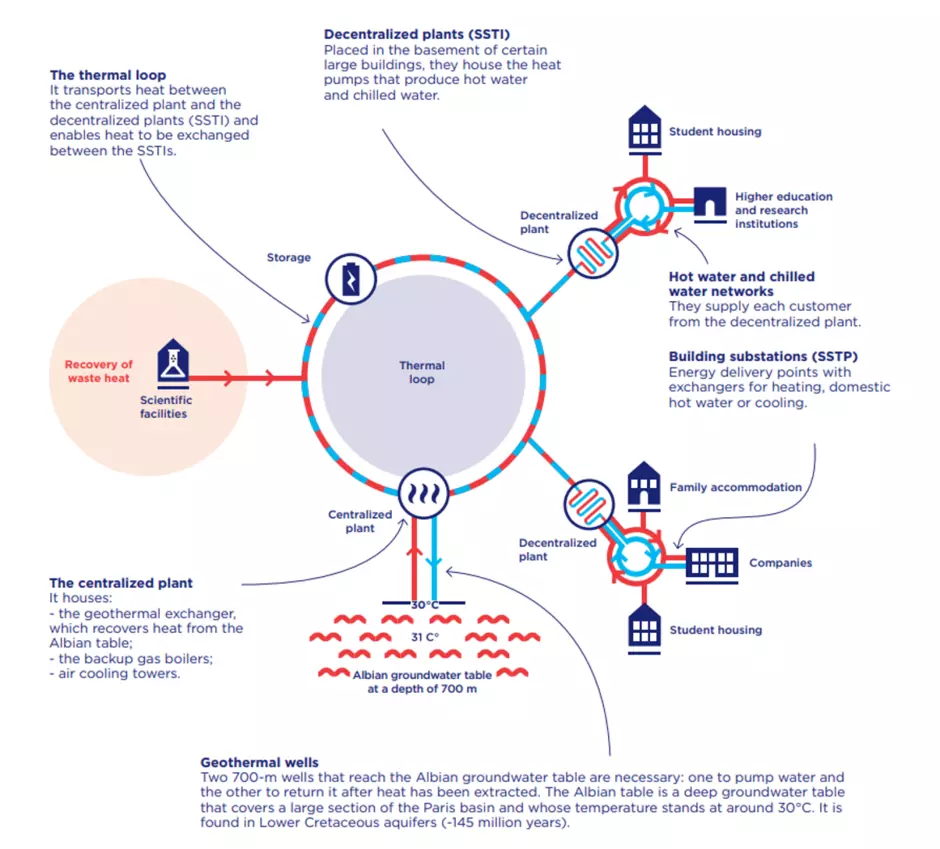
Paris-Saclay operates a "5th generation" network using ambient temperature loops (10-30°C) rather than traditional chilled water systems. This fundamental difference allows buildings to exchange thermal energy with each other, one building's waste heat becomes another's heating source.
Specific advantages:
- Renewable energy rate: >50% through deep geothermal (700m wells at 31°C) and waste heat recovery from data centers
- Dual service delivery: Provides both heating and cooling through the same infrastructure
- Decentralized production: Heat pumps at building level allow customized temperature control while reducing distribution losses
- Lower infrastructure costs: Ambient temperature pipes require less insulation and can use smaller diameter networks
Hong Kong application potential: While Hong Kong has minimal heating demand, the ambient loop concept could enable waste heat recovery from our numerous data centers, laboratories, and industrial facilities to pre-cool incoming water, reducing chiller loads during peak periods.
🇦🇺University of Sunshine Coast, Australia: Thermal Energy Storage as a Virtual Battery
Key Innovation: Large-scale thermal energy storage integrated with solar power
What makes it different from Hong Kong:
USC treats chilled water storage as an electrical battery equivalent, using a massive 4.5 million liter thermal energy storage (TES) tank, effectively functioning as an 8MW electrical battery, to time-shift cooling production to match solar generation.
Specific advantages:
- 40% grid electricity reduction by producing and storing cooling during peak solar hours
- 2.1 MW rooftop solar dedicated primarily to operating HVAC, with carport shade structures maximizing space efficiency
- Advanced demand management: Real-time switching between solar, grid, and stored chilled water minimizes cost and emissions
- Water conservation: Ultrafiltration system uses campus lake water for cooling towers, saving 802 megalitres of potable water
- Refrigerant innovation: First in Australia to use environmentally-friendly HFO gases in ceramic bearing chillers
Hong Kong application potential: Hong Kong's limited land makes rooftop solar particularly valuable. Coupling solar installations with thermal storage could help our district cooling systems reduce afternoon peak demand, our most expensive and carbon-intensive electricity period, while providing grid stability services.
🇧🇭Bahrain Bay: Seawater Integration and Multi-Utility Synergy
Key Innovation: Integrated cooling, water treatment, and distribution in a single facility
What makes it different from Hong Kong:
Bahrain Bay's Combined Utilities Plant integrates district cooling with sewage treatment and water reuse in a closed-loop system, using seawater for heat rejection instead of freshwater cooling towers.
Specific advantages:
- Zero potable water consumption for cooling tower makeup through seawater use
- Circular water economy: Treated sewage effluent (TSE) irrigates landscaping and provides cooling system makeup water
- Space optimization: Combined facility eliminates need for individual building chillers, increasing net leasable area
- Advanced treatment: Membrane Bioreactor (MBR) technology produces high-quality effluent with 90%+ sludge dryness
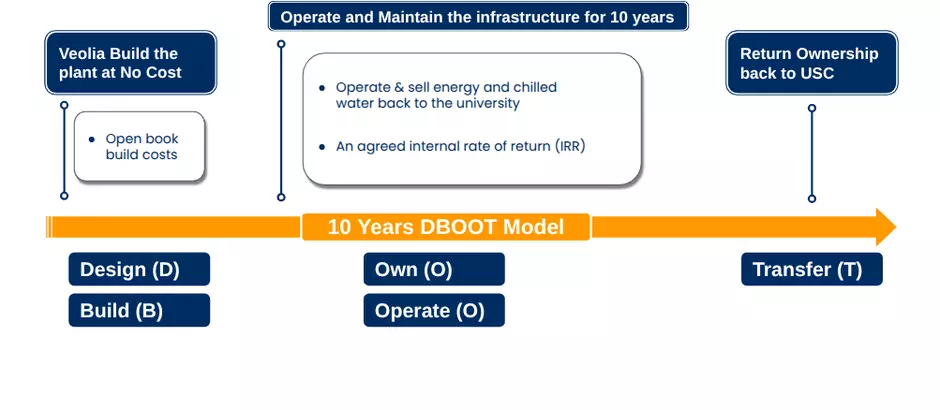
- Long-term commitment: 75-year BOT contract (longest in operator's portfolio) ensures sustained performance
Hong Kong application potential: As a coastal city with water scarcity concerns, Hong Kong could explore seawater cooling for waterfront developments while integrating water reclamation facilities with district cooling infrastructure. This approach could significantly reduce potable water consumption in our cooling systems.
Key Takeaways: Pathways for Hong Kong's District Cooling Evolution
- Embrace Thermal Energy Storage
Large-scale chilled water storage can transform district cooling systems into grid assets, providing demand flexibility and enabling greater renewable energy integration, critical as Hong Kong pursues its 2050 carbon neutrality goal. - Integrate Renewable Energy Strategically
While Hong Kong's building density limits ground-level solar deployment, coupling rooftop solar with thermal storage in district cooling systems maximizes the value of every solar panel by time-shifting production to match generation. - Consider Lower-Temperature Distribution
Ambient temperature networks enable waste heat recovery and reduce distribution losses. While full 5th generation systems may not suit Hong Kong's climate, hybrid approaches could capture waste heat from data centers and industrial facilities. - Adopt Holistic Multi-Utility Planning
Integrating district cooling with water treatment, renewable energy, and waste heat recovery creates synergies that improve overall system efficiency and resilience.
As Hong Kong continues developing new districts and retrofitting existing infrastructure, these global innovations offer proven pathways to more sustainable, efficient, and resilient urban cooling. The question isn't whether to adopt these approaches, but how quickly we can adapt them to our unique context.